
Home battery storage, with or without solar
A home battery stores electricity so you can use it when it is most valuable: solar generated at midday used in the evening, or cheap off-peak grid power used at peak times. Extract Energy installs Sigenergy SigenStor and Tesla Powerwall 3 across Hampshire. We are approved installers of both. Batteries fitted with or without solar are 0% VAT until 31 March 2027.
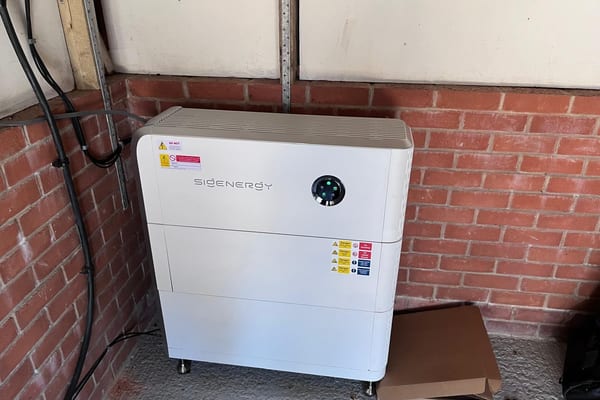
How a home battery saves money
Three ways, and most households use at least two.
Solar shifting
Without a battery, a working household exports most of its solar for a few pence per unit and buys it back at night for 25p or more. A battery keeps the midday generation for the evening. Self-consumption typically rises from around 40% to around 70%.
Off-peak charging
Several suppliers now offer tariffs with a cheap overnight window, sometimes a small fraction of the daytime rate. The battery fills up at night and runs the house during the day. In winter, when solar is thin, this is where the saving comes from. You do not need solar panels to benefit.
Backup
Configured with a backup circuit, both the SigenStor and Powerwall 3 can keep essential loads running during a power cut: the fridge, the router, lights, the boiler controls. It needs to be designed in, so tell us if it matters to you.
Two great batteries. One trusted installer.
We are approved installers of both Sigenergy SigenStor and Tesla Powerwall 3. We will recommend the right one for your home at the survey — the choice depends on your existing setup, your goals, and your budget.
Sigenergy SigenStor
Modular, scalable, all-in-one
Tesla Powerwall 3
All-in-one solar and battery system
Sizing your battery
Bigger is not always better. A battery you never fill is money sitting on a wall. We size from three numbers: your daily usage, your solar generation if you have it, and the cheap-rate window on your tariff. Many households land somewhere between about 6 and 14 kWh of usable capacity; large homes with heat pumps and EVs may want more. Because SigenStor is modular, starting smaller and adding later is a real option. Powerwall 3 comes as a fixed 13.5 kWh unit, with a second unit stackable if needed.
Retrofitting a battery to existing solar
If you already have panels, a battery can be added. For SigenStor, we either connect it on the AC side or replace the existing inverter with SigenStor's hybrid unit. For Powerwall 3, it connects on the AC side of your existing inverter. We check your current system, your export arrangement and your DNO notification, and sort out any that need updating. Battery-only installs have been 0% VAT since February 2024 and remain so until 31 March 2027.
Installation process and safety
Survey
Where the unit will go (garage, utility, under the stairs if there is room; not a bedroom), cable routes, consumer unit capacity, and your usage data.
Design and quote
Capacity, battery recommendation, backup requirement if any, tariff recommendation, written quote.
DNO notification
Batteries count as generation for grid purposes. We notify or apply as required.
Install
Half a day to a day for a battery alone; combined with solar it is part of the main install. Wall or floor mounted, dedicated circuit, isolation, labelling.
Commissioning
We set up the app, configure the tariff schedule and backup, test, and hand over the paperwork including the electrical certificate and MCS registration where applicable.
All our battery work is carried out by qualified electricians to BS 7671, under our MCS certification for battery installation (MIS 3012), and the installation is registered.
Guide prices (0% VAT until 31 March 2027)
Installed prices including hybrid inverter where applicable. VAT is 0% until 31 March 2027, then 5%.
| Battery & capacity | Guide price (0% VAT) |
|---|---|
| SigenStor ~6 kWh (one 6 kWh module) | from £3,600, typically £3,800 to £4,800 |
| SigenStor ~9 kWh (one 10 kWh module) | from £4,600, typically £4,800 to £6,200 |
| SigenStor ~12 kWh (two 6 kWh modules) | from £5,600, typically £5,800 to £7,200 |
| SigenStor ~18 kWh (two 10 kWh modules) | from £7,500, typically £7,800 to £9,800 |
| SigenStor optional DC EV charging module | add from £3,500 |
| Tesla Powerwall 3 (13.5 kWh) | contact us for a written quote |
Adding a battery to a solar install at the same time is cheaper than adding it later, because the inverter and electrical work are shared. The written quote after your free survey is the one that counts. Prices as at October 2026.
Battery storage vs solar panels: payback at a glance
Both technologies reduce your bills — but they work differently. Solar generates electricity; battery storage captures it. Together they give you the best return. Figures are indicative for a typical Hampshire semi-detached home.
| Factor | Solar PV only | Battery storage only | Solar + battery |
|---|---|---|---|
| Typical installed cost | £7,000 – £9,000 | £4,000 – £7,000 | £11,000 – £16,000 |
| VAT rate (until Mar 2027) | 0% | 0% | 0% |
| Estimated annual saving | £400 – £600 | £200 – £400 | £700 – £1,100 |
| Typical payback period | 12 – 16 years | 10 – 18 years | 10 – 14 years |
| Smart Export Guarantee income | Yes — export surplus | No (no generation) | Yes — export after charging |
| Works without solar? | N/A | Yes — charges from grid off-peak | Yes |
| Warm Homes Loan eligible | Yes | Yes | Yes |
| MCS certification required | Yes | Yes | Yes |
Savings estimates based on a 4kWp solar system, 10kWh battery, and an electricity price of 24p/kWh. Actual savings depend on your usage, tariff and roof orientation. Payback periods assume no change in electricity prices. Get a free survey for figures specific to your home.
Frequently asked questions
Which battery should I choose — SigenStor or Powerwall 3?
It depends on your home, your existing setup and your goals. Powerwall 3 has a built-in solar inverter, making it ideal for new solar installs, and offers whole-home backup. SigenStor is modular so you can start smaller and scale up, and it has an optional DC EV charging module. We will recommend the right one at your free survey.
How many kWh do I need?
Many households land between about 6 and 14 kWh of usable capacity. It depends on your daily usage, your solar output and the length of your cheap-rate window. We size it from your bills, and because SigenStor is modular you can add capacity later. Powerwall 3 is a fixed 13.5 kWh unit.
Can I add a battery to existing panels?
Yes. For SigenStor we either fit it alongside your current inverter or replace the inverter with SigenStor's hybrid unit. Powerwall 3 connects on the AC side of your existing inverter. Battery-only retrofits are 0% VAT until 31 March 2027.
Will it work in a power cut?
Both batteries support backup, but in different ways. Powerwall 3 is designed for whole-home backup and switches seamlessly when the grid goes down. SigenStor backup covers a designed-in circuit rather than the whole home. Tell us at the survey if backup is important and we will design for it.
Is battery storage 0% VAT?
Yes. Battery storage installed in a home in Great Britain, with solar or on its own, is zero-rated until 31 March 2027, after which the rate returns to 5%.
Find out what a battery would do for your bills
Free survey. Bring your bills and your tariff and we will show you the numbers.