
Bonded bead cavity wall insulation, installed by people who fix bad installs for a living
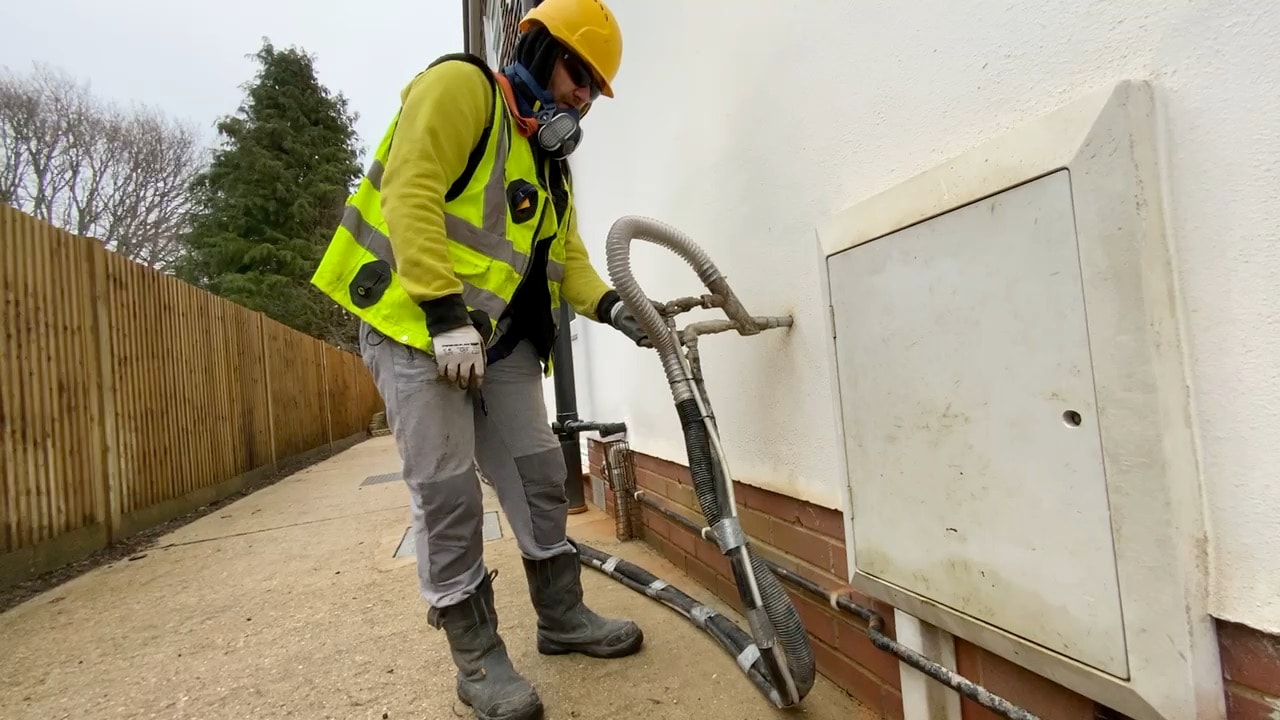
Bonded bead cavity wall insulation is made of small expanded polystyrene (EPS) beads blown into the wall cavity with a bonding agent. The beads do not absorb water, flow around obstructions to fill evenly, and set into a stable mass that will not slump. We are a ThermaBead approved installer and every installation carries a 25-year IAA guarantee.
We spent our first years in business taking failed insulation out of walls, and we still do. So when we chose a system to install, we chose the one we had never been asked to remove because it had got wet. That was bead.
Why bonded EPS bead and not mineral wool?
Most of the cavity wall insulation we extract is blown mineral wool. It is cheap, and in a sheltered inland house with perfect brickwork it can be fine. On the South Coast, in older walls, it has a poor record. Bead behaves differently:
It does not absorb water
Polystyrene is closed-cell. Rain that gets through the outer leaf runs down between the beads and out at the bottom, the way a cavity is meant to work. Mineral wool holds it against the inner wall.
It fills evenly
Beads flow like dry sand. They go round wall ties, pipes, lintels and the mortar snots that are in every cavity, with far fewer voids than fibre pumped in under pressure.
It does not slump
The adhesive bonds the beads to each other as they settle. Ten years on, the top of the wall is still full.
It stays put if you open the wall
Loose bead pours out when a window is changed. Bonded bead holds its shape, so your builder is not sweeping up polystyrene.
No fibres, no formaldehyde
Nothing to irritate skin or lungs, nothing to off-gas.
It is breathable
Moisture vapour moves through the fill rather than being trapped.
We would rather point you at the Energy Saving Trust's cautious numbers than a manufacturer's: roughly a third of heat loss from an uninsulated house goes through the walls, and typical payback on cavity wall insulation is five years or less.
We are ThermaBead approved and Kiwa approved
ThermaBead is a British manufacturer of bonded bead systems. Its Diamond injected bead system holds Kiwa BDA Agrément certification (BAW-18-061-S-A-UK and BAW-22-251-S-A-UK). We are a Kiwa approved installer of cavity wall insulation (installer number 579075) and an approved installer of ThermaBead's carbonsaver product. In practice that means our operatives are trained on the system, our work is assessed and surveilled by Kiwa, and the product goes in to the certified method.
ThermaBead also runs its own cavity clearance service, ThermExtract, which tells you something: the manufacturer agrees that a cavity should be cleared of failed fill before new insulation goes in. That is how we have always worked.
Kiwa approved installer
Installer number 579075
IAA 25-year guarantee
Insulation Assurance Authority
Suitability survey first. We turn down unsuitable homes.
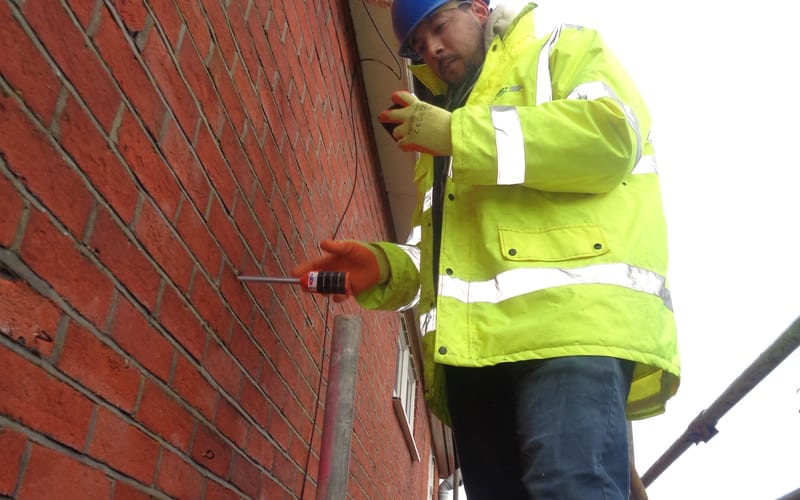
Before we quote, we visit, drill a 10mm inspection hole and put a borescope into the cavity. We are checking for:
- A cavity width of at least 50mm, consistent across the wall
- Rubble, mortar droppings or old fill that needs clearing first
- Wall tie condition
- The state of the brickwork, pointing and render
- Gutters, downpipes and roof edges that might be soaking the wall
- Signs of existing damp inside
- Construction type (we will not fill timber or steel frame)
- Exposure. Coastal, west-facing and high, open walls in Gosport, Portsmouth, Hayling and the Isle of Wight take a lot of wind-driven rain and need the wall in first-class condition before any fill goes in.
If your house fails, we tell you, and we tell you what would need doing first: repointing, a new gutter, render repair, or extraction of the old fill. We would rather lose a job than create one for ourselves in five years' time.
Our installation process
Survey and quote
Written quote with the guarantee terms included.
Extraction if needed
If there is failed fill or heavy debris in the cavity, we remove it first and let the wall dry before we come back. That is a separate visit.
Preparation on the day
We sheet the ground, protect windows and doors, check the airbricks and flues, and mark out the drilling pattern. Holes are drilled in the mortar joints, not the brick faces, so making good is near-invisible.
Injection from the bottom up
Bead and bonding agent are blown in through the lowest holes first, then progressively higher, so the cavity fills from the base and we can see it rising on the borescope. This is how you avoid voids.
Checking and making good
We check fill at the top of each wall with the camera, then fill every hole with colour-matched mortar. Airbricks are sleeved so they stay clear. Flues and gas appliances are re-checked.
Paperwork
You receive a completion certificate and the 25-year IAA guarantee documents, and photos of the work are available on request. Most three-bed houses are done in a day.
What you will save
We will not quote you a bills figure we cannot stand behind. What we can say is this: in an uninsulated cavity wall house, about a third of the heat you pay for is going out through the walls. Fill the cavity properly and most of that stops. The Energy Saving Trust puts typical payback at five years or less, and the insulation will still be working long after that.
What you notice first is not the bill. It is that the bedroom on the windward side is no longer the cold one, and the walls do not feel cold to touch.
25-year IAA guarantee and paperwork
Every bonded bead installation comes with a 25-year IAA Able To Pay (ATP) guarantee covering defects in materials and workmanship. It is issued through the Insulation Assurance Authority, which audits our installations, rather than being a promise from us alone. A suitability assessment of your property before we install is one of the conditions of the guarantee, which is one more reason the survey comes first.
You also get a completion certificate, and the photos we took are available on request. Your solicitor will want the paperwork when you sell.
Cost
Guide prices for bonded bead installation into an empty, suitable cavity. VAT is 0% until 31 March 2027, then 5%.
| House type | Guide price (0% VAT) |
|---|---|
| Flat or maisonette | from £1,000, typically £1,100 to £1,500 |
| Terrace | from £1,300, typically £1,400 to £2,000 |
| 2 to 3-bed semi-detached | from £1,900, typically £2,100 to £2,800 |
| 3-bed detached bungalow | from £2,300, typically £2,400 to £3,100 |
| 3-bed detached | from £3,000, typically £3,200 to £4,200 |
| 4-bed detached | from £3,800, typically £4,000 to £5,200 |
For comparison, the Energy Saving Trust puts the typical cost of cavity wall insulation in Great Britain at around £2,200. Our prices sit a little higher for a semi because bonded bead costs more than mineral wool and the 25-year IAA guarantee is included. If old fill has to come out first, that is quoted separately. Final price confirmed in writing after the free survey. Prices as at October 2026.
Full insulation price guideFunding
Eligible low-income households in England can have cavity wall insulation fully funded through the council-run Warm Homes: Local Grant. Our guide explains the three qualification routes and the process.
Warm Homes: Local Grant guideHousing associations and landlords
We install bonded bead across portfolios, with RAMS, photo packs and tenant liaison built into the process. See the landlords and housing associations page for how we work on void and tenanted properties.
Landlords and housing associationsFrequently asked questions
How long does installation take?
Usually one day for a three-bed semi or detached house. Larger houses or awkward access can run into a second day.
Will bead insulation cause damp?
No, provided the wall is suitable and in good condition, which is what the survey is for. EPS bead does not absorb water, so unlike mineral wool it cannot become a wet bridge across the cavity. Moisture drains down between the beads and out.
Do you remove old insulation first?
If there is failed or wet insulation in the cavity, yes. Filling on top of old fibre is a bad job and we will not do it. Extraction is a separate visit, and we let the cavity dry before we come back to install.
What guarantee do I get?
A 25-year IAA Able To Pay guarantee on the installation, covering materials and workmanship, plus a completion certificate.
Do I need planning permission?
No. Cavity wall insulation is internal to the wall and does not change the appearance of the building. In a listed building or conservation area it is still worth a conversation with the council, and we can advise.
Can it be done in winter?
Yes. The bonding agent and bead are not weather-sensitive in the way render or paint are. The one thing we will not do is fill a wall that is soaking wet from a leak or a blocked gutter, in any season.
What if I later need to open the wall?
Bonded bead holds its shape. If a window is replaced or a new doorway is cut, the bead stays in the cavity rather than pouring out across the floor. Your builder can cut through it and reseal the edges.
Find out if your home is suitable
Free borescope survey across Hampshire. If bead is right for your house we will tell you. If it is not, we will tell you that too.